Requirement
Store/feed balls
Function
Hold balls in hopper
Subsystems
Detachable Ball Hopper
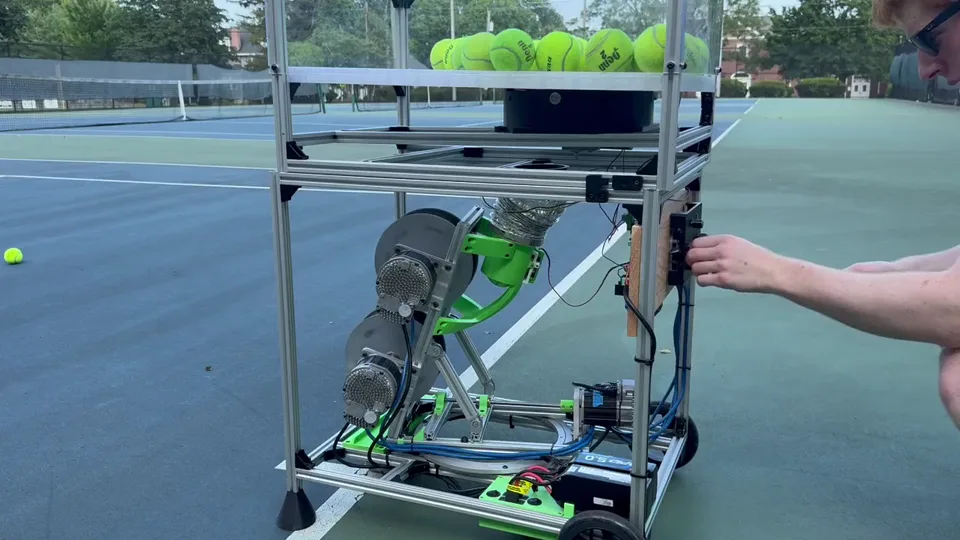
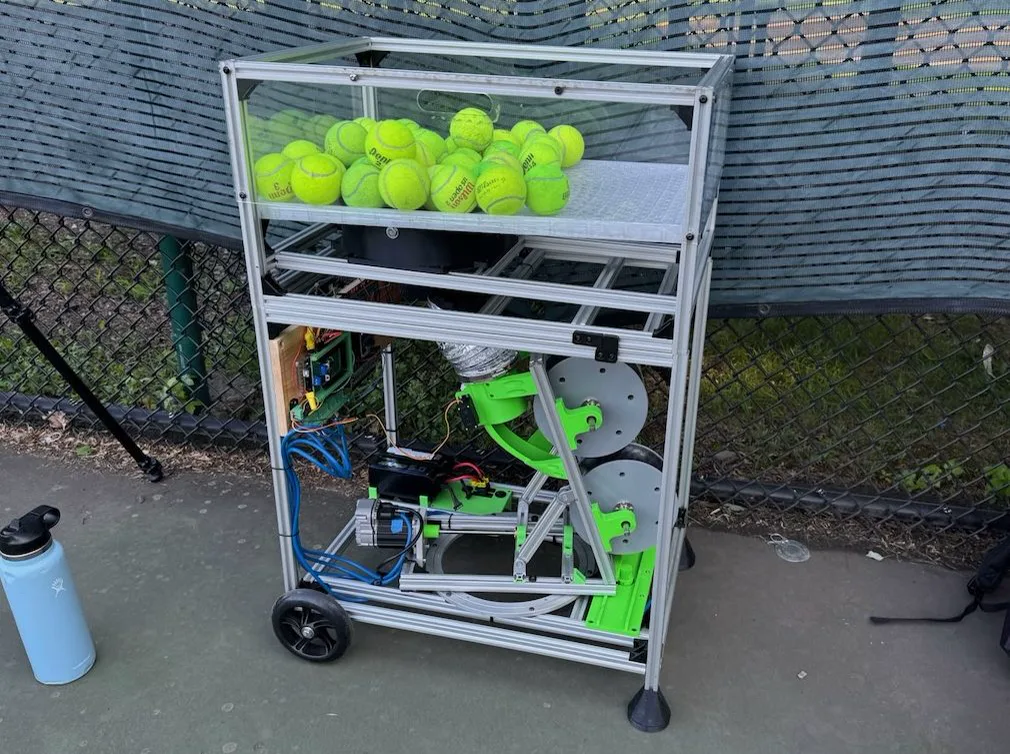
Custom ball machine complete with pan, tilt, speed, spin, and feed rate control.
Tap a number to learn more. Tap on a label to learn more. Hover on a label to learn more.
Pan Mechanism
Rotates the tilting assembly left/right for horizontal aim.
Tilt Mechanism
Rotates the throw wheel assembly up/down for vertical aim.
Vertical Throw Wheels
Accelerates and launches the tennis balls using two counter-rotating wheels.
Detachable Ball Hopper
Stores a pile of balls to be fed into the downstream feed paths.
Ball Tube
Carries queued balls from the carousel to the ball gate while the throw assembly moves.
Ball Carousel
Converts disorganized ball storage in the hopper into a linear, single-ball queue.
Ball Gate
Releases exactly one queued ball at the requested feed interval.
Transport Wheels
Allows rolling the machine on and off the court for easy transport.
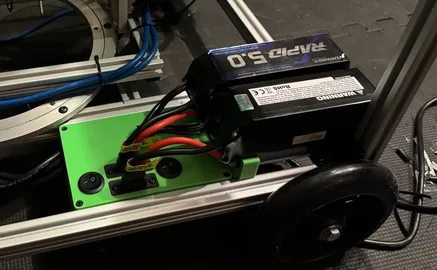
Battery Power Module
Supplies portable power for motors, controls, and sensors.
Control Panel
Gives the operator direct control over aim, speed, spin, feed rate, and other advanced modes.
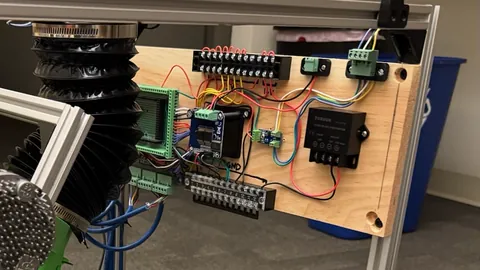
Electronics Board
Houses electronic components that facilitate user input, voltage step-down, motor driving, and display.
Pan Mechanism
Rotates the tilting assembly left/right for horizontal aim.
Tilt Mechanism
Rotates the throw wheel assembly up/down for vertical aim.
Vertical Throw Wheels
Accelerates and launches the tennis balls using two counter-rotating wheels.
Detachable Ball Hopper
Stores a pile of balls to be fed into the downstream feed paths.
Ball Tube
Carries queued balls from the carousel to the ball gate while the throw assembly moves.
Ball Carousel
Converts disorganized ball storage in the hopper into a linear, single-ball queue.
Ball Gate
Releases exactly one queued ball at the requested feed interval.
Transport Wheels
Allows rolling the machine on and off the court for easy transport.
Battery Power Module
Supplies portable power for motors, controls, and sensors.
Control Panel
Gives the operator direct control over aim, speed, spin, feed rate, and other advanced modes.
Electronics Board
Houses electronic components that facilitate user input, voltage step-down, motor driving, and display.
Requirement
Function
Hold balls in hopper
Subsystems
Requirement
Function
Feed balls into tube
Subsystems
Requirement
Function
Send balls to throw wheels
Subsystems
Requirement
Function
Accelerate balls to launch speed
Subsystems
Requirement
Function
Pan launcher left/right
Subsystems
Requirement
Function
Tilt launcher up/down
Subsystems
Requirement
Function
Vary throw wheel speeds
Subsystems
Requirement
Function
Create vertical wheel speed differential
Subsystems
Requirement
Function
Fit in SUV trunk
Subsystems
Requirement
Function
Roll onto court
Subsystems
Requirement
Function
Operate without wall power
Subsystems
Requirement
Function
Detect entries to ball tube
Subsystems
Requirement
Function
Hold balls in linear queue
Subsystems
Requirement
Function
Release balls onto launch path
Subsystems
Requirement
Function
Accept input and command actuators
Subsystems
The ball hopper is responsible for two functions: storing all of the balls that will be used during play, and guiding the balls to the next sub-system, to eventually be fed to the throw wheels. Because the end result is to have the balls form a linear queue before entering the throw wheels, I considered storing the balls in the hopper in a similar, linear fashion.
One idea was to have a spiral that the balls would be fed into by the user and rest in before being sent to the wheels. However, this requires the user to fill up the balls neatly instead of being able to dump them in, and a spiral doesn’t have a great packing density in the hopper. Another consideration was to have a “magazine” style system that utilized pre-existing tennis ball pick-up tubes. The user would fill up a tube, lock it onto the machine, and then it would index the tube and remove balls one by one. However, this would require multiple tubes since each only has a ~20 ball capacity, and would likely be cumbersome to the user.
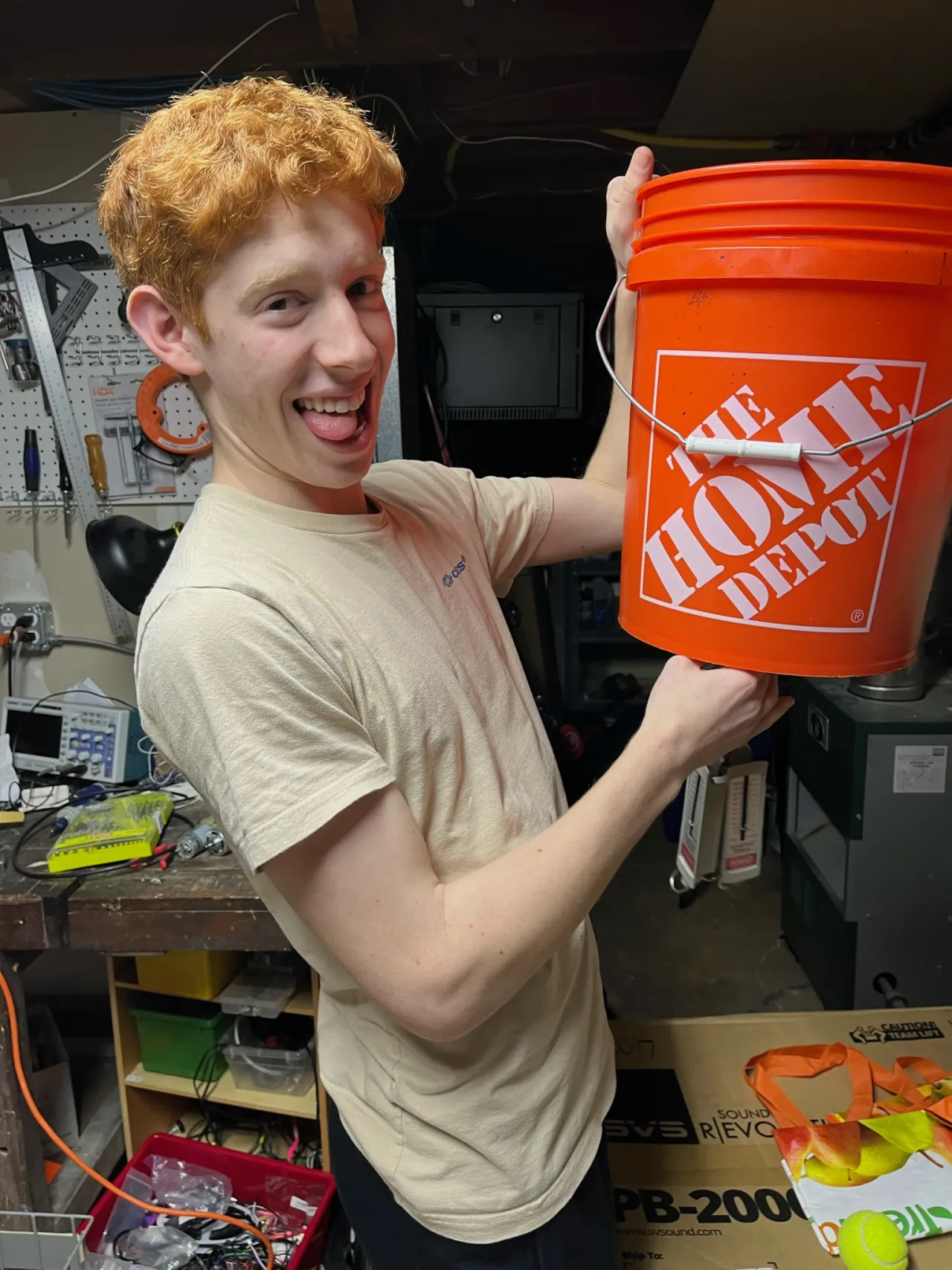
The concept I settled on was a simple hopper that holds all balls in a disorganized way, and then passes them into a ball carousel to extract each ball one at a time. The carousel has holes that fit one ball each, and as it rotates, the balls in the carousel line up with the exit hole and get released. This is the most common method that machines on the market use today, based on my research. My first prototype used a Home Depot bucket. It worked in small capacities, but once more balls were added, the down pressure from all the balls caused friction and jams. This concept was too vertical: it concentrated all the balls directly above the carousel instead of spreading them out to the side.
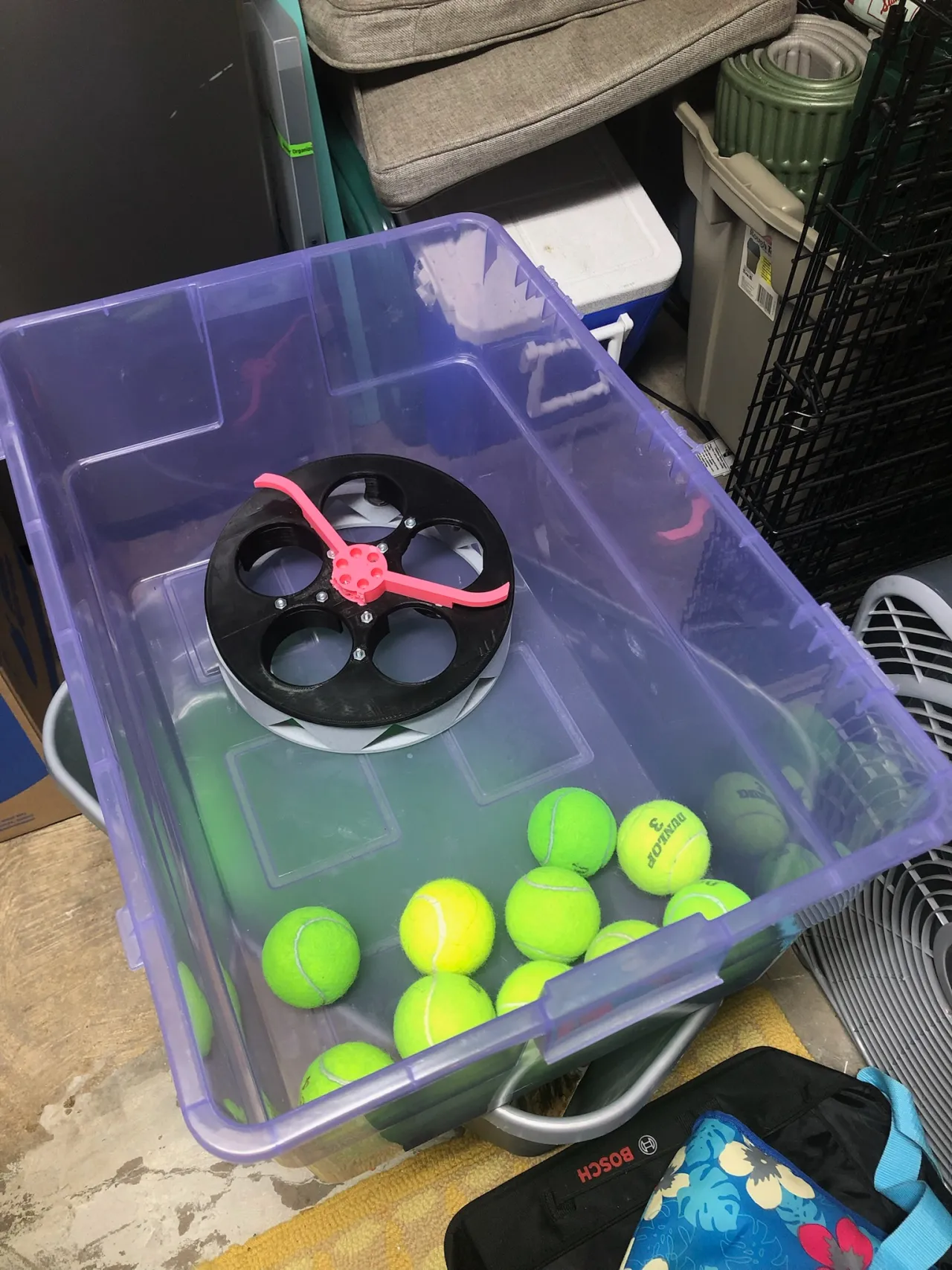
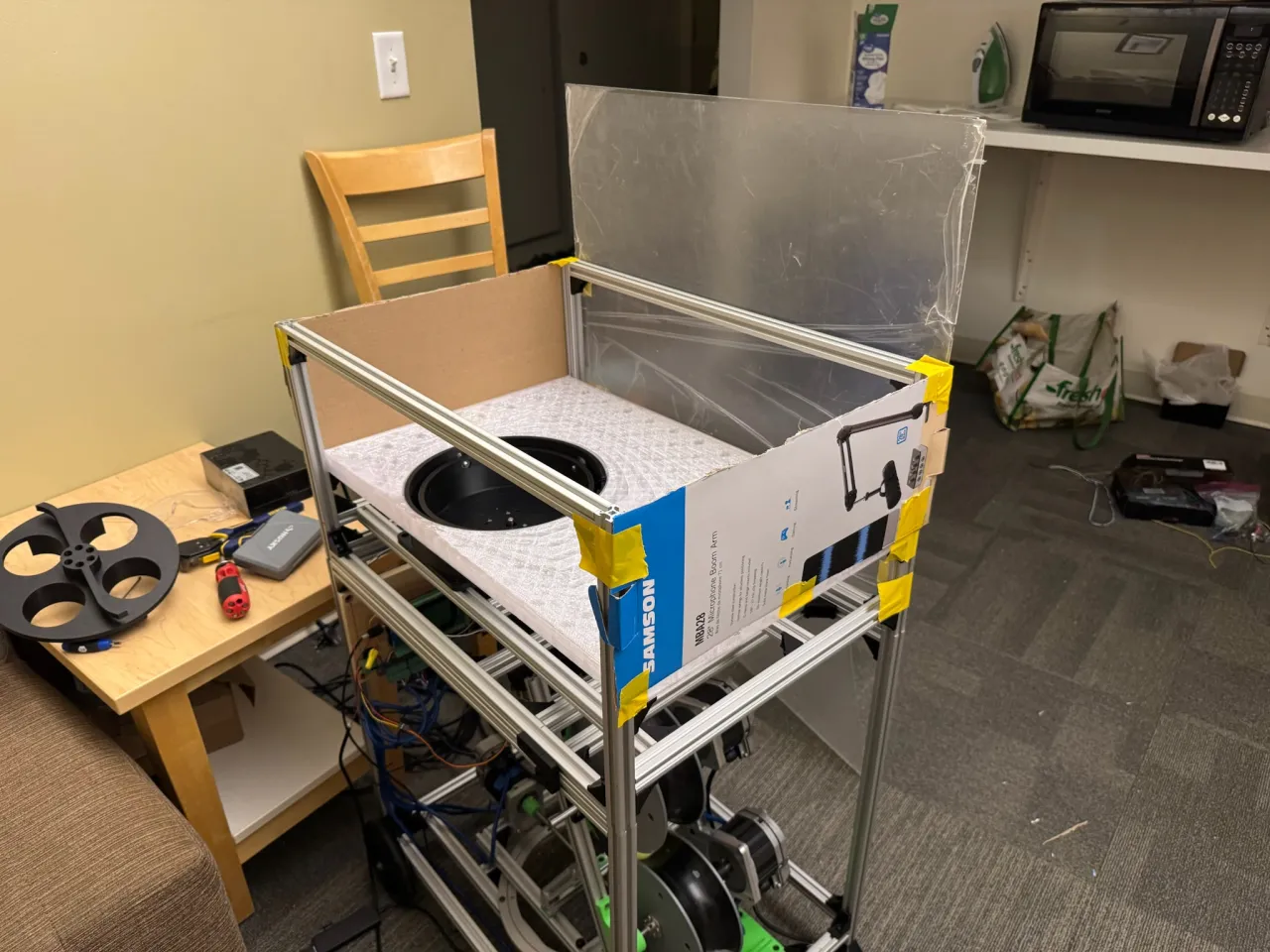
My second prototype used a much wider, rectangular box. This allows the balls to spread out horizontally, and the angle of the ramp controls how much downwards force they induce on the carousel (now proportional to the sine of the angle instead of the full weight). But besides that, it also gives balls room to escape horizontally if the carousel gets too crowded. Before, if balls got stuck, they couldn’t spread out because of the tight, vertical walls of the bucket.
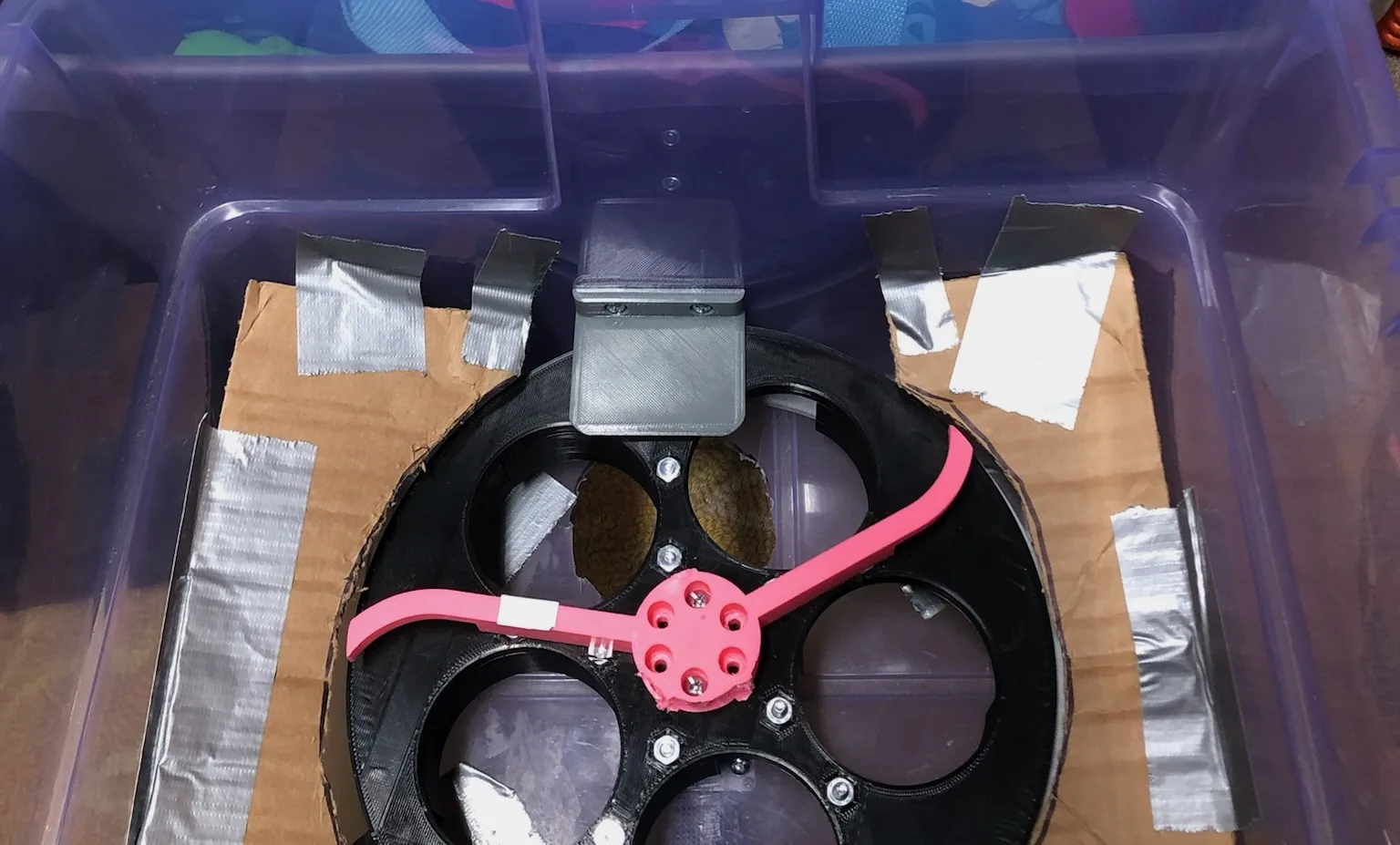
This worked very well, but still had one key issue: when the ball over the exit hole got released, there was nothing preventing another ball from taking that position, and either causing a double-fire or a jam. The solution was to add a TPU flap that sits over the exit hole and does not allow a ball to enter from the top. TPU is a flexible material that can be FDM 3D printed, and in this case avoids jams by flexing out of the way if necessary.
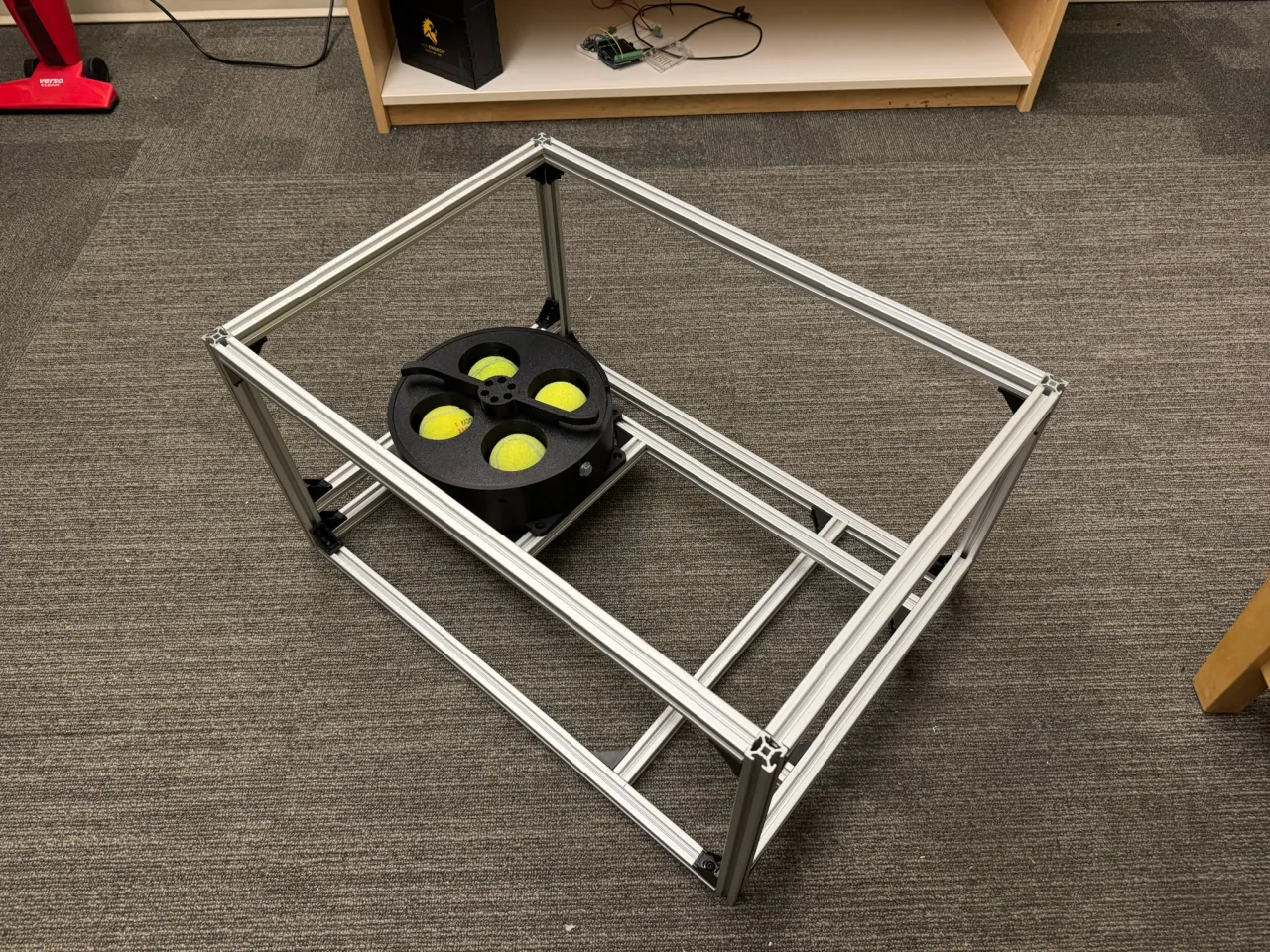
When I moved onto the aluminum frame build, I slightly redesigned the carousel.
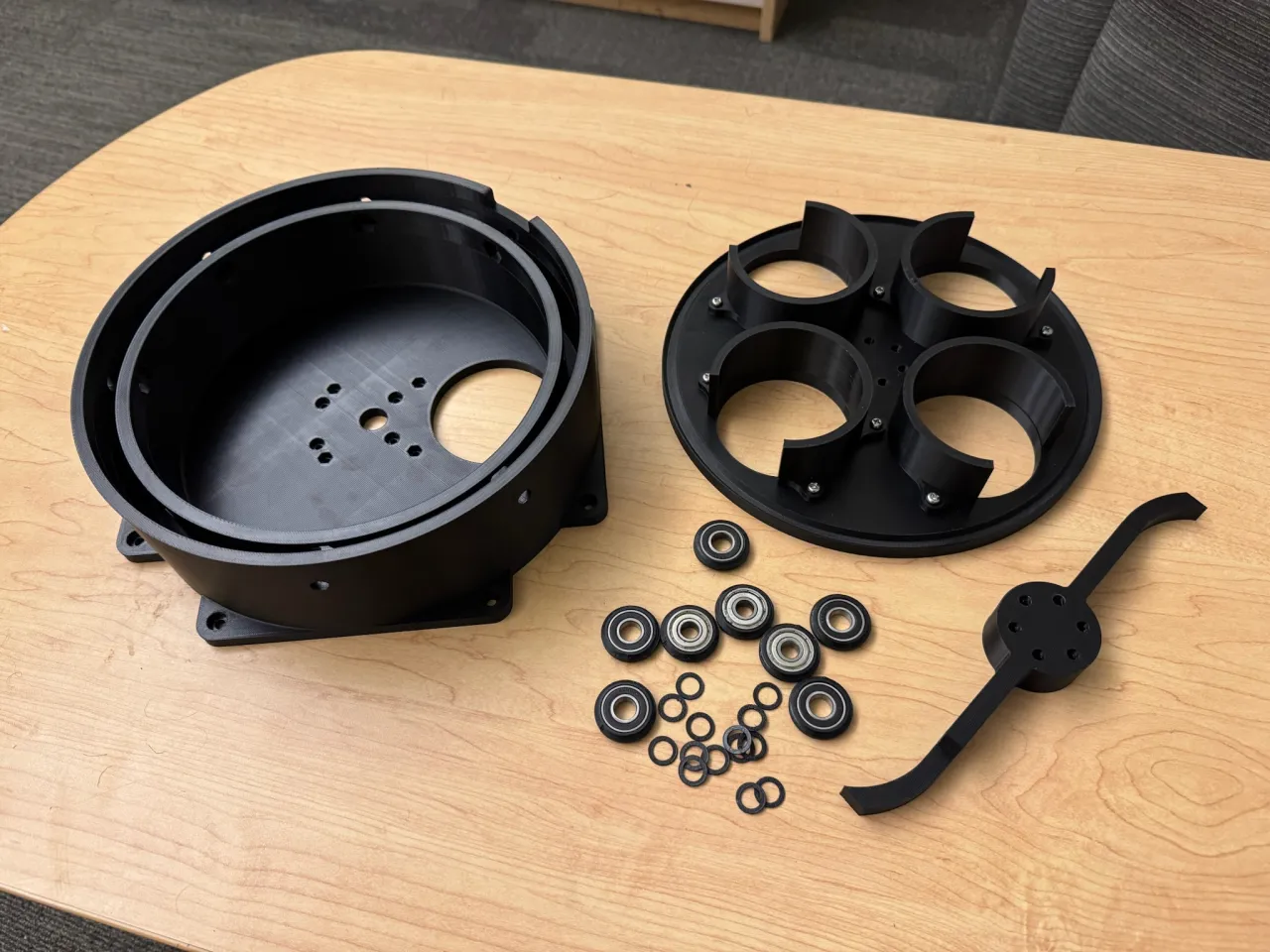
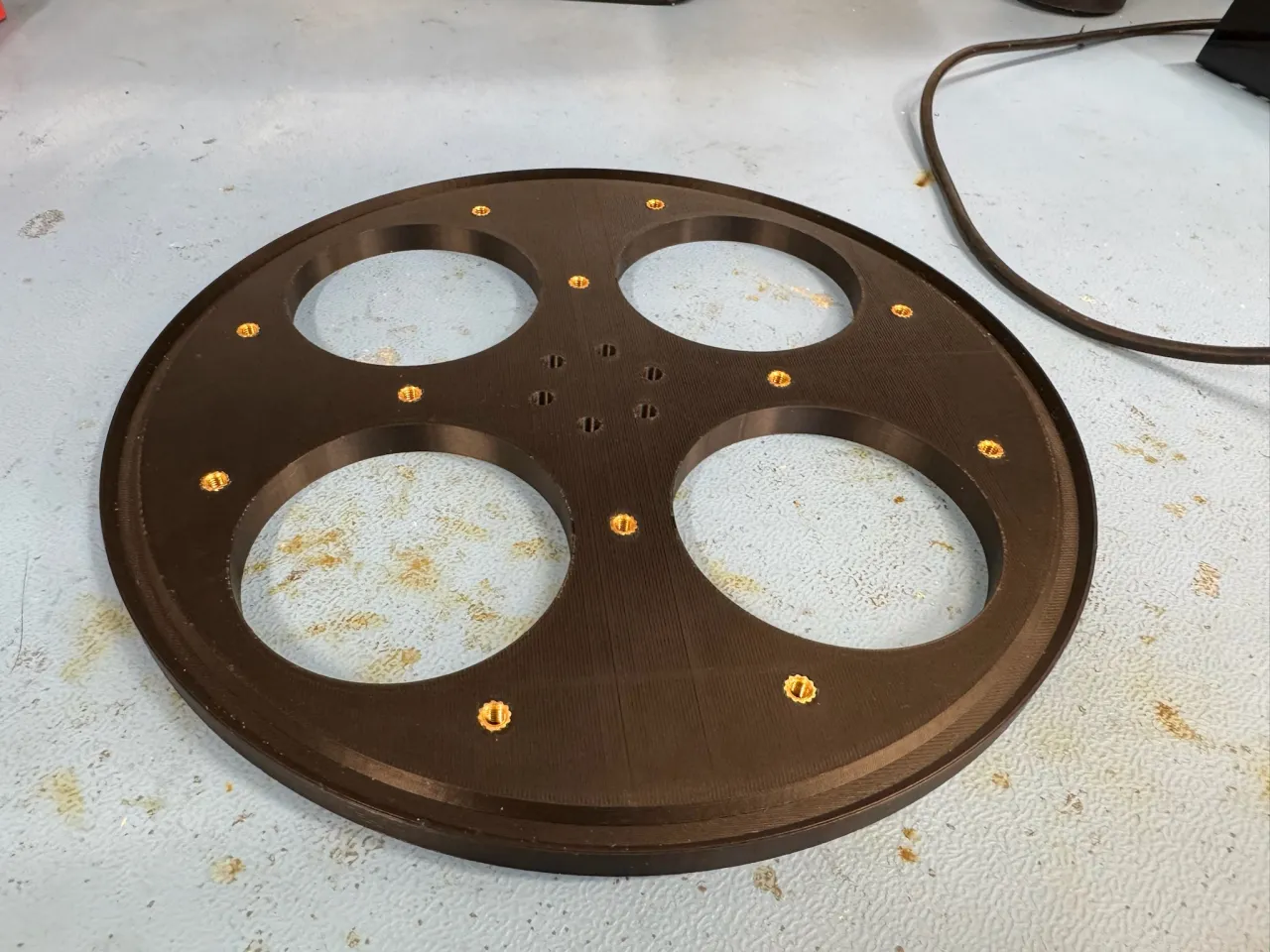
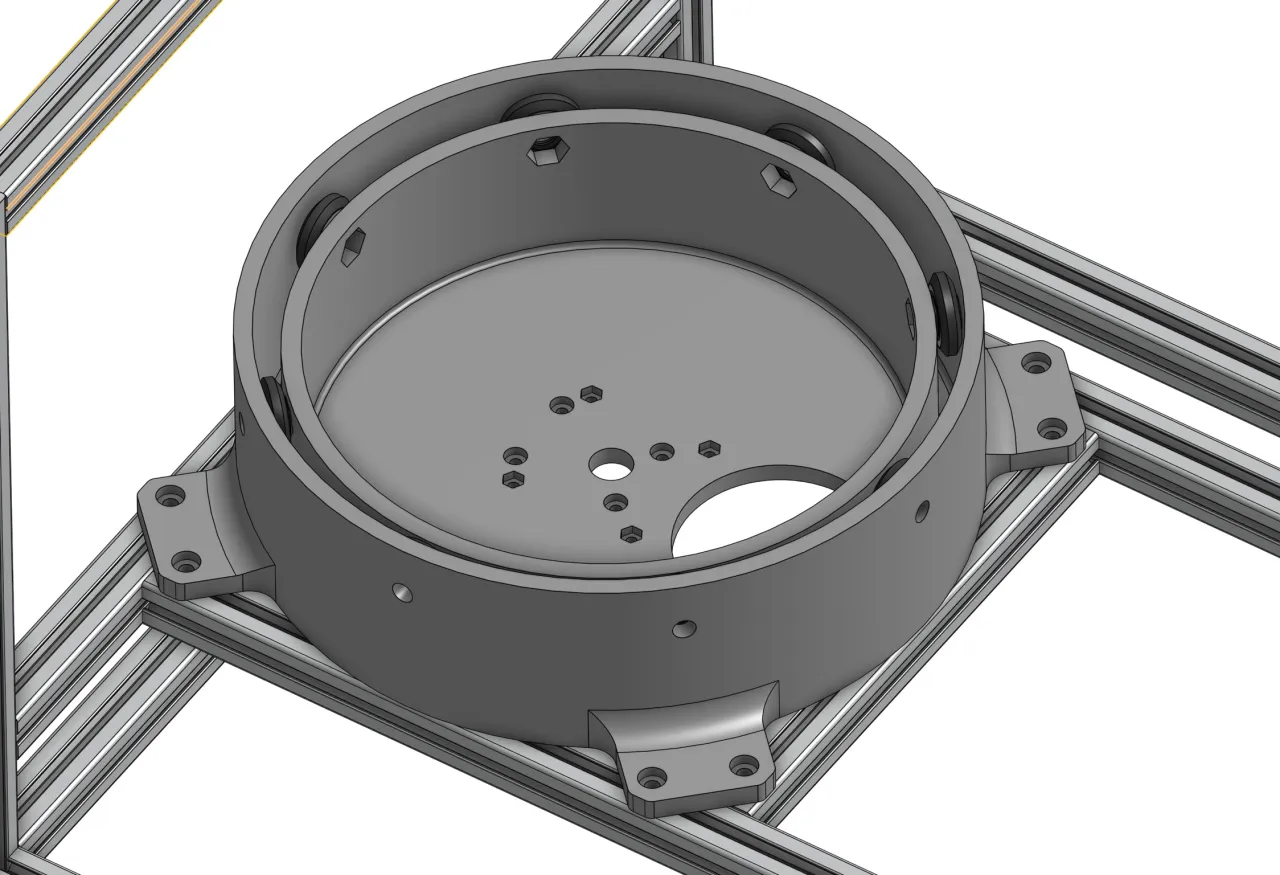
The carousel itself is composed of a few key components: the housing, the shaft, the disk, the rollers, the agitator, and the stop. The housing is the large 3D printed cylindrical part that mounts to the frame and houses all other components of the carousel. The bottom has a mount for the motor and an exit hole to release one ball at a time. The shaft couples to the output “D-shaft” of the wormgear-drive motor and is bolted onto the bottom of the disk to rotate it. The rollers are skateboard bearings with V-shaped wheels snapped onto them which nest into the matching V-shaped groove on the underside of the disk, allowing for smooth and stable rotation. The disk has 4 cups mounted to the underside which guide each ball around the carousel internally. The agitator is a simple arm that mounts on top of the carousel to “agitate” the balls as it spins, ensuring they move around and find their way into one of the holes in the disk. Without it, the disk could spin underneath the balls without forcing them to move since the tennis ball felt on plastic is relatively low-friction. Finally, the TPU flap from the earlier prototype was replaced with the stop: a simple wire spanning across one hole, since there wasn’t a nearby wall to mount the flap to in the new design.
The cardboard ramps in the prototype worked surprisingly well, but I needed to find a more robust, permanent solution of course. A vacuum-formed plastic insert would be ideal, but would be expensive since I would need to make a one-time mold. I also considered stacking multiple sheets of foam and using a CNC router to cut out a smooth, continuous piece. I also considered laser cutting multiple pieces of thin plywood and combining them with 3D printed contours for the corners.
Ultimately, I decided to utilize the large-format FDM 3D printer on RIT’s campus and 3D print the entire ramp in one piece. To optimize for cost and reduce the load on the carousel, I opted for a very shallow loft angle. However, I forgot to account for the coarse layer lines of the low-resolution print, and balls were still able to get stuck if placed the right way. It works well enough for now, but will eventually be replaced.
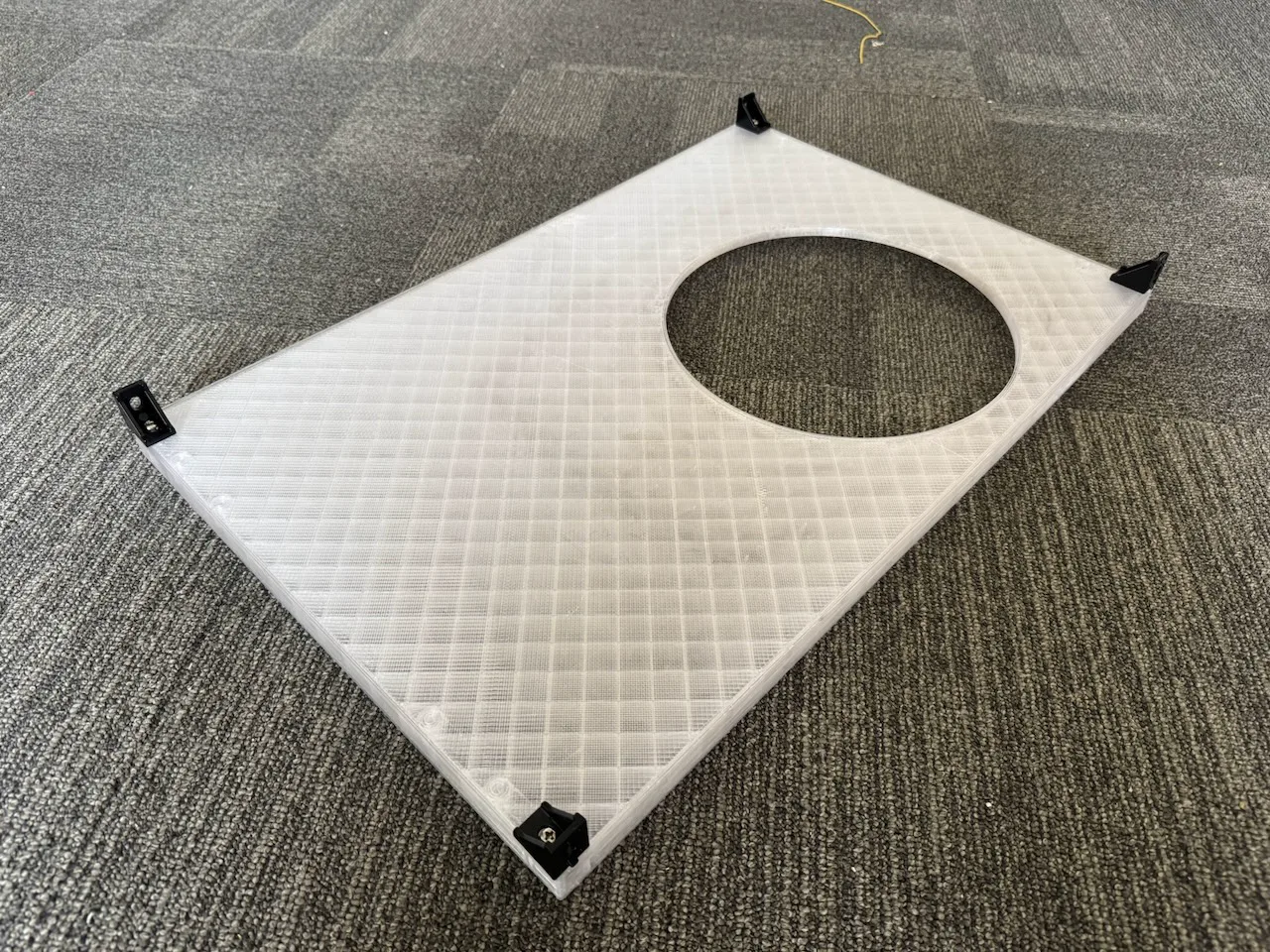
Also, once I moved from the plastic bin to the aluminum frame, I needed a way to enclose it to actually hold the balls. I laser cut some acrylic panels and bolted them on the four sides.
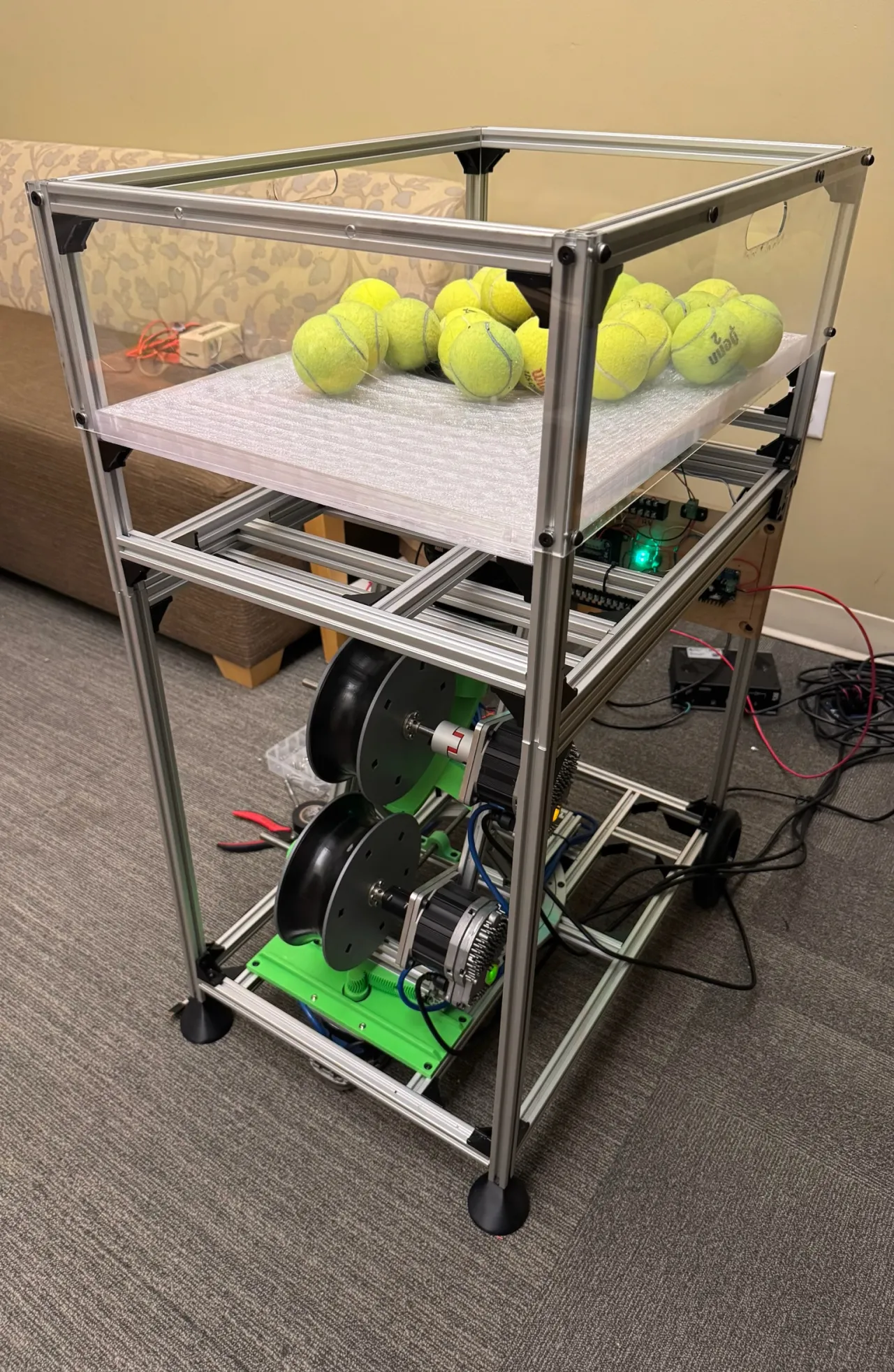
Once a ball is released from the carousel, it needs to make its way to the feed ramp, and eventually into the throw wheels. However, since the entire throwing assembly can articulate in both pan and tilt, I couldn’t have a static pathway connecting the two subsystems. Instead, I opted for a flexible tube that can expand, contract, and flex to accommodate the wide range of end positions of the tube. To ensure that the tube would be capable of guiding the balls to any possible position, I spent a lot of time selecting the start position of the tube. The side-to-side position was selected to align with the throw wheels, and the front-to-back position was selected to make sure balls couldn’t get stuck in either of the tilt extremes. The ball carousel needed to line up with this placement, and the placement of the ball carousel drove the design of the ball ramp, so I had many design dependencies to work through.
The carousel is designed to spin at a constant rate (driver is fed a constant PWM value from the Arduino), but it’s not a closed loop system, so the speed could fluctuate, especially as the battery dies. I would need to add in an encoder or sensor of some sort for position/velocity feedback. But even if the carousel did spin at a constant rate, it’s possible (albeit rare) that some holes in the carousel are skipped. On top of this, the distance that the ball must travel from the carousel to the ball ramp depends on the position of the ramp, since it can tilt up and down.
Because I wanted to have precise control over the timing of each shot (to allow for advanced features like drills or hitting specified targets), and because of the way my specific Teknic ClearPath brushless servos work (read more on that below), I realized that the timing from the carousel alone wouldn’t be good enough.
I considered different options of how to improve timing from the ball carousel, or handle the ball feeding in completely different ways, but I couldn’t come up with a good, single-actuator solution. So, I decided to introduce a new component: the ball gate. The carousel is responsible for converting the resting balls in the hopper into a linear queue, and the ball gate is responsible for delivering each ball to the feed ramp with precise timing control (read more on the ball gate below).
This new addition also introduced a queue of balls in the ball tube. While this is good if you want to release multiple balls in quick succession, it can become a problem if they overflow. To prevent this, the machine needs to know how many balls are in the tube at any given time so it can stop the carousel from adding more if necessary.
The 3D printed part that the top of the tube clamps onto also has an IR break-beam sensor, consisting of an emitter and receiver. When a ball enters the tube, the receiver no longer sees the IR light from the emitter, and the balls_in_tube counter is incremented by 1. When the gate is opened to release a ball, the counter is decremented by 1. At any given moment, if the current value of balls_in_tube is greater than the desired, the carousel is commanded to stop. And if the opposite is true, the carousel is commanded to spin (with smooth acceleration and deceleration built in).
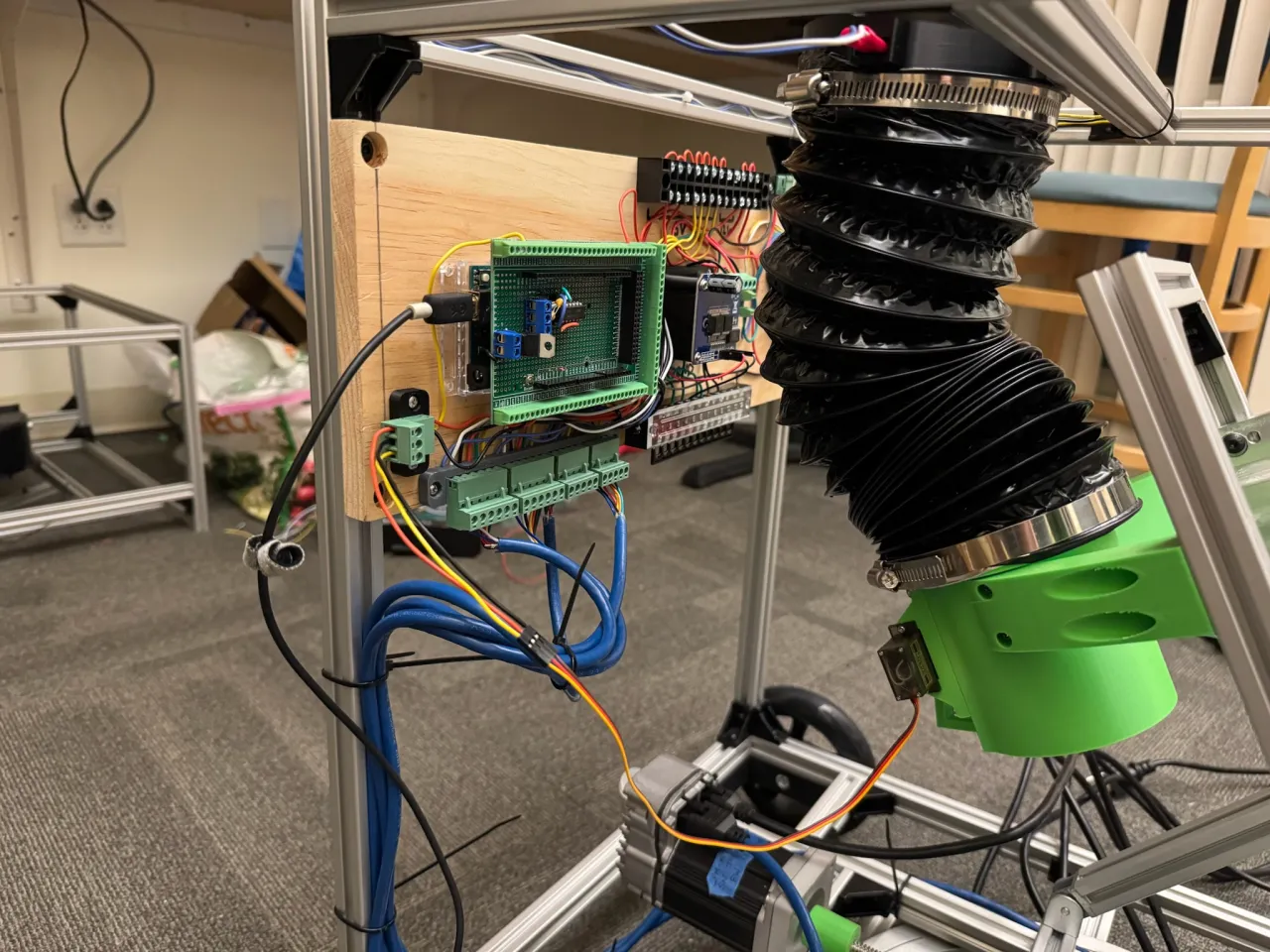
The main component in the ball gate assembly is a 3D printed tube with a hobby-style servo motor attached. The servo drives a lever that pivots within a plastic tube. It uses a two-action release mechanism that allows one ball to drop while the next one is held out of the way. In the “closed” position, one ball is held in its “exit” position, while the next one rests on top of it. When the gate opens, that ball is released, and the top of the gate holds the next ball up and out of the way. When the gate resets back to its “closed” position, that next ball is allowed to drop and wait in its “ready” position, and the cycle continues.
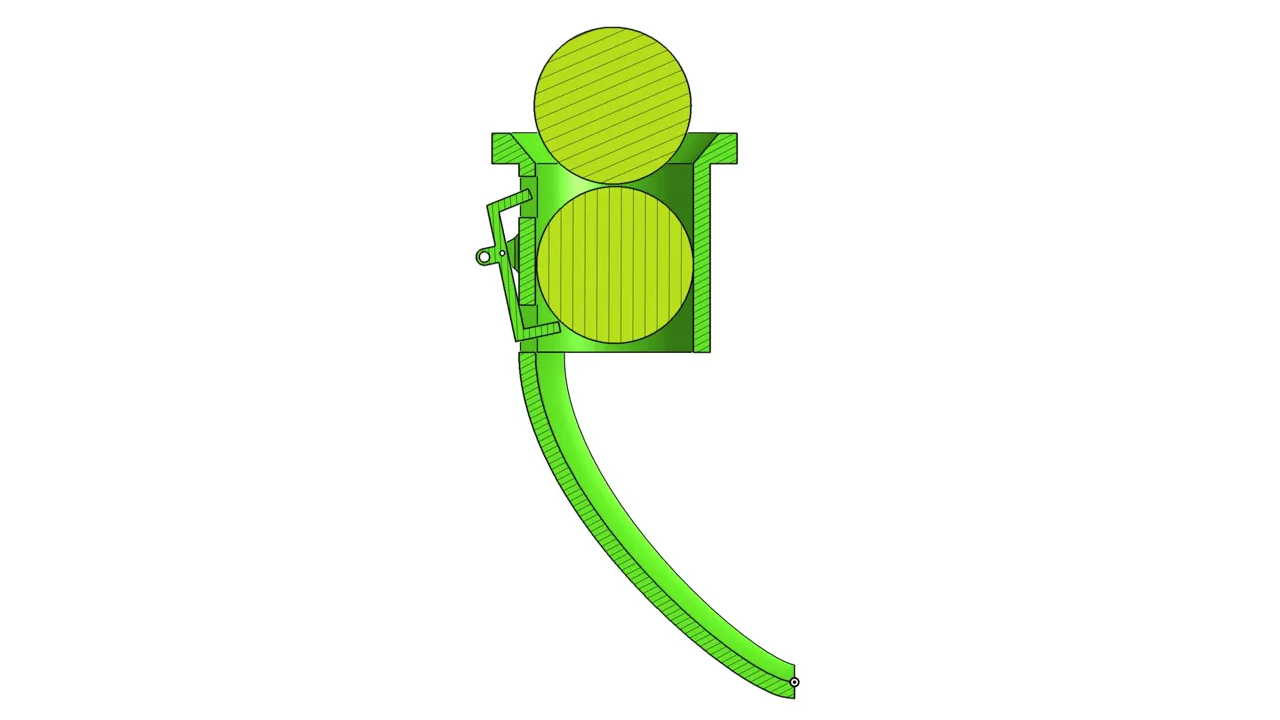
The ball gate assembly also features connecting arms that bolt onto the tilting frame, and a ramp attached to the bottom, called the feed ramp, which is responsible for guiding the balls into the throw wheels. This assembly and many other 3D printed assemblies in the project use heat-set inserts, which add strong internal threads to the prints and allow me to screw the parts together without worrying about them stripping.